
FSC UK / Edward Parker
FSC Trace is now available!
In this support hub you'll find all the training and resources you need to confidently get started with FSC Trace.
The platform is now open to all FSC certificate holders, demonstrating readiness and building the foundation for digital traceability. This release provides the essential tools companies need to begin exploring and adopting the tool. Regular updates and enhancements will follow as we continue building the full experience.
Learn how FSC Trace empowers seamless data flow throughout the entire supply chain to deliver both verification and traceability of supply chains, whilst safeguarding commercial confidentiality and ensuring participants are always in full control of their data.
FSC Trace is now open to all FSC certificate holders and offers core functionalities to enable end-to-end traceability.
If you are part of a certified organization, your Primary Contact can already access FSC Trace through FSC Connect. After logging in to FSC Connect, FSC Trace can be found on the app menu on the top right.
If you don’t have an FSC Connect account or need access to FSC Trace, reach out to the Primary Contact for your organization to ask them to set you up with an account and grant you permission to use FSC Trace.
We invite you to explore FSC Trace, connect with your supply chain partners, and share feedback to help us improve. For this launch, we are prioritizing the core functionalities – getting users on the platform, connecting them to their trading partners, configuring their products, and entering their first transactions, and we will gradually add new features, updates and enhancements to cater for more complex needs, supply chains and license scopes.
If you are the Primary Contact of a certified organization, log in to FSC Connect with your credentials.
If you are not the Primary contact and don’t have an account yet, reach out to the Primary Contact in your organization to ask them to set you up with an account and grant you permission to use FSC Trace.
You will then follow the sign-up process in which you will activate your account and set up your access credentials.
After accepting the terms and conditions for FSC Trace, the Primary Contact can add more users and assign them permission to use FSC Trace.
Once logged in, locate the FSC Trace icon in the app menu (top right corner), then select the organization you will be working with. Now you’re all set and can begin adding products and trading partners and then start using FSC Trace to record your transactions.
We are developing a series of step-by-step tutorials, to help users get started and use the platform.
Currently the available materials only cover the basic functionality, but we are working on developing feature specific videos to address basic and advanced features.
We have step-by-step guides covering some features and processes for using FSC Trace. You can either view these documents online or download them for later use.
The release handbook is currently available in English, Spanish, French and Chinese. The specific guides, however, are only available in English and Spanish.
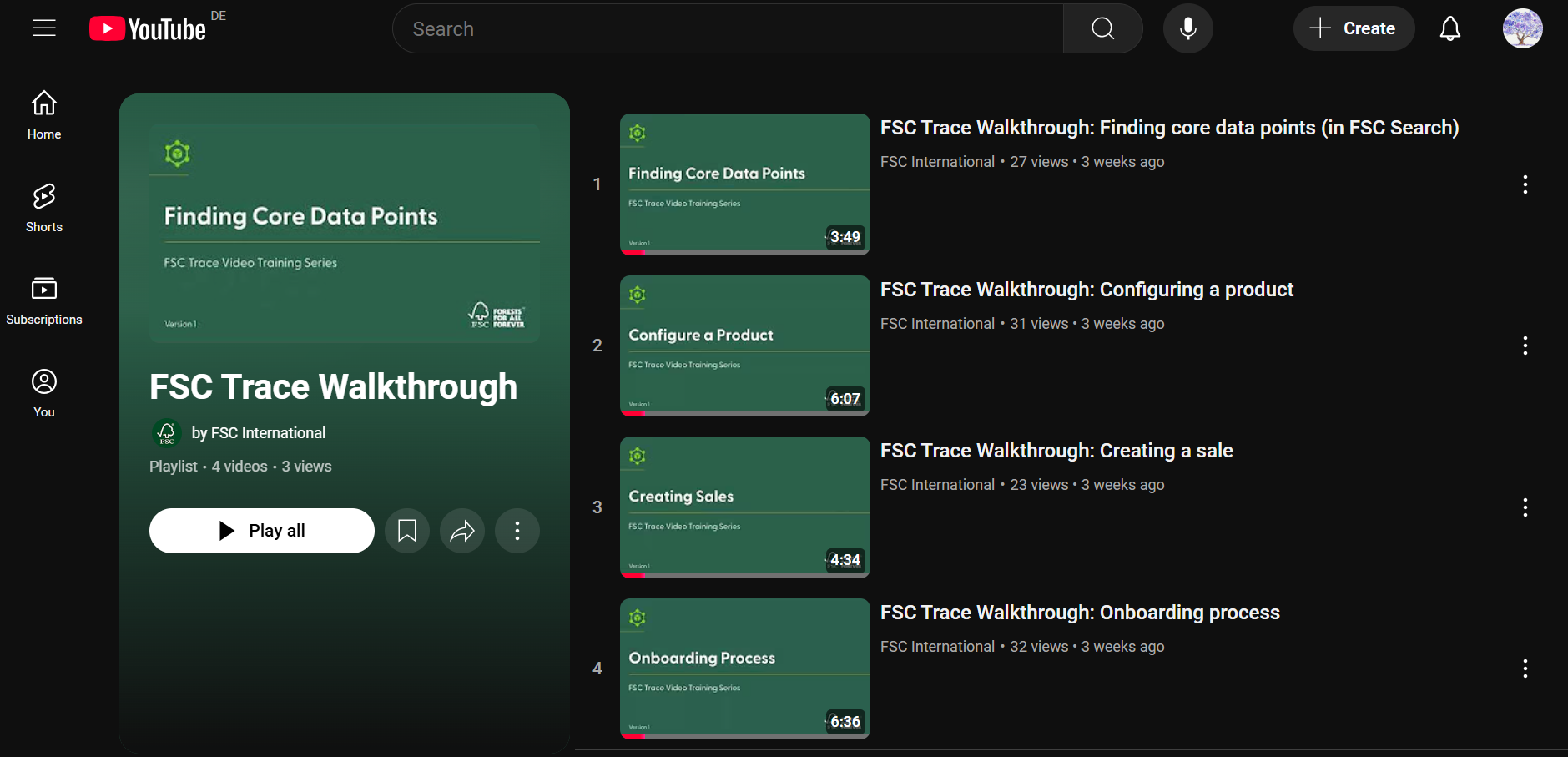
We have a dedicated YouTube playlist with step-by-step video tutorials on how to use FSC Trace. The tutorials cover various features and processes.
We will be uploading new videos regularly to cover a wide range of features.
These videos are available in English with captions in Spanish, French and Chinese.
FSC Trace is available for all FSC Licence Holders through FSC Connect. To ensure you have access to FSC Trace, you can check if you fulfill the following requirements:
To access FSC Trace, you need an active account on FSC Connect, as you will need it to log in. If you don’t have an FSC Connect account, reach out to the Primary Contact in your organization to ask them to set you up with an account and grant you permission to use FSC Trace. Check our detailed guide on how to access FSC Trace for more information.
As of December 2025, FSC Trace is available to all Certificate Holders who have a valid Electronic Trademark Licence Agreement (eTLA) or have initiated the signature process.
Promotional Licence Holders will have access to FSC Trace in 2026.
Check our detailed guide on how to access FSC Trace for more information.
Only the Primary Contact in your organization can add users. This is done via the Contact Management tool in FSC Connect, which you can find on the app menu after logging in. Here the Primary Contact can add, edit or delete users and give them access to FSC Trace. Check our detailed guide on how to add users to FSC Trace for more information.
Your Certification Body designates the Primary Contact for your organization; please reach out to them to find out who this person is. They are also the only ones who can change your Primary Contact, hence you need to notify them of any updates or changes.
To assist users with the onboarding process and daily use of FSC Trace, we will provide a library of support materials. These materials will include step-by-step video tutorials and written guides.
To cater to our global user base, we will develop support resources in English, Spanish, French and Simplified Chinese.
These resources will be available directly on FSC Connect and on our YouTube channel. For users based in China, these materials will also be available on FSC Chinese social media and FSC China’s website.
Currently we have 3 tutorial videos available in all languages on our dedicated YouTube playlist and a couple of written guides. More feature-specific videos are under development and will be added gradually to our FSC Trace walkthrough series as they become available.
This blend of resources and live support is part of our commitment to making the transition to and usage of FSC Trace as smooth and efficient as possible for all our users.
Trading parties must agree on key information for a transaction to be written to the blockchain, following these matching rules:
Once one of the trading partners has uploaded a transaction to FSC Trace, all the details will be visible to their counterparty, with the exception of the quantity details. For a transaction to be matched and written to the blockchain the counterparty (the user who didn’t record the transaction) must enter the quantity to ‘match’ and accept the transaction. The quantity entered must fall within an error margin of ±5% of the figure entered by the first user. If the difference exceeds 5%, the system will not match the transaction.
Note that it is not necessary to match transactions one by one. You can use the bulk upload: if the data you upload corresponds to what was already provided by your counterparty, the transaction will be matched automatically, and written to FSC Trace, without creating duplicated transactions.
Since data on a blockchain is immutable, submitted data cannot be deleted. However, mistakes will inevitably be made when entering data, so it is possible to record corrections to data that has already been entered on FSC Trace.
Similar to how edits are captured in accounting systems, FSC Trace will record the updated information as a new entry which is marked as a correction to the original one. If the edit is done to a matched transaction, the change will have to be agreed by your trading partner, and the supply chain status will change from “Active” to “Unmatched” with this visible to all downstream trading partners.
There are several methods for uploading data:
Direct Entry: Individual products, transactions and trading partners can be recorded manually through FSC Trace. This method is most appropriate for small companies with only occasional trades, and when first learning how FSC Trace works.
Bulk Uploads: Companies can opt for bulk uploads of spreadsheets, which can cover a maximum of 1000 entries per file. This method is efficient for managing large volumes of data. The spreadsheet templates are available for download directly from FSC Trace.
A key aspect of FSC Trace is its capability to automatically handle various elements of the FSC certification process. This includes managing your product inventory and the invoices of your transactions, for both sales and purchases.
It will also maintain a list of trading partners and verify their ongoing certification for every transaction. By automating these tasks, FSC Trace will relieve licence holders from the need to manage these lists externally, significantly reducing their administrative burden.
Yes, you can invite FSC-certified trading partners to join your supply chain, record, and match transactions you have with them.
Yes, you have the flexibility to decide how extensively you use FSC Trace to manage your products.
It's possible to use FSC Trace for only a selection of your products. This selective usage allows you to tailor the blockchain's benefits to your specific needs, whether for certain product lines, markets, or compliance requirements.
However, it's important to note that if FSC Trace is not used for all products, the generated volume summaries may not encompass your entire operation, which could impact the comprehensiveness of data available for FSC audits.
FSC Controlled Wood, which are forest-based products verified as low risk and permissible in limited volumes within the FSC system, is supported by FSC Trace.
In FSC Trace there is a dedicated but optional field for the forest manager to upload this data.
As with all data uploaded to FSC Trace, this geolocation data can be shared with downstream users, but only if the data owner – the forest manager, in this case – chooses to do so.
In the initial stages of FSC Trace's deployment, there is no automatic validation for the correctness of the recorded harvest locations.
FSC Trace is designed with flexibility in mind, accommodating various production processes, including those not managed in batches.
In such scenarios users will be able to use different criteria, e.g. date ranges or first-in-first-out rules, to select the inputs which could have contributed to a set of outputs. This approach aligns with regulatory requirements, such as under EUDR, in which you can specify a super-set of known supply sources from which the actual specific sources are not known for a given product, but where it is known that it contains no forest product contents from sources outside that super-set.
It is important to note that currently FSC Trace offers basic functionality. This feature will continue to be improved and enhanced to cater to additional workflows, scenarios, and market changes.
Currently the system does not support recycled materials.
FSC Trace can handle the complexity of products composed of multiple species, a common scenario in the forest products industry. When configuring a product in FSC Trace, users can select multiple species that are used in their products.
No, the current version of FSC Trace does not support the grouping of multiple locations into a single entry. Forest managers are required to upload geolocation data for harvest sites individually using GeoJSON files.
In FSC Trace, the journey of a product is segmented into three distinct phases: incoming volume, production process, and sales.
When recording production processes, the input products contributing to a specific batch of outputs are recorded. The data attached to these inputs, including the original geolocations and harvesting times, will be associated with the output products. This will maintain traceability back to the point(s) of origin.
FSC Trace is designed to accommodate the complexities of real-world transactions, including invoices that feature multiple products. The system recognizes the diversity of products that are included in a single transaction and treats each line on an invoice as a separate transaction item. This ensures detailed traceability and verification for each product, regardless of how they are grouped in financial documents.
Here's how it works:
Individual Line Entries: Each line on an invoice is entered as a separate line item. This can be done through batch uploads using spreadsheets, where each line represents a different product, or through individual entries on FSC Trace.
Flexibility in Product Management: By treating each product line as a separate claim, FSC Trace allows for greater flexibility in managing and tracking products. Products from different invoices or suppliers can be combined or traced individually in the following stages of production or sales.
Enhanced Traceability: This method prevents the aggregation of product data into a single, indistinguishable batch. Instead, it maintains the distinct identity of each product, facilitating precise traceability across your own company and into that of your customers.
Blockchain, in simple terms, is a secure digital ledger that records transactions across multiple computers in a permissioned network. At FSC, we utilize this technology to enhance the trust and transparency of our global forest certification process.
You can think of blockchain as a non-editable digital logbook, used by FSC to ensure the trustworthiness of our global forest certification process. In this digital logbook, we create a chain of 'blocks,' each containing important information about forest certification and the products that derive from the forest.
Now, imagine this logbook is shared among companies, who trade with each other. Each of these companies has their own copy of the logbook. When they want to add a new forest-based product or update existing information, both trading partners must agree that the information is correct.
Once both parties agree, the new information gets written into their logbooks, and this information is linked to the previous one, creating a chain. What's unique is that once something is written in this logbook, it cannot be erased. It's like writing in pen instead of a pencil. So, if anyone tries to tamper with the information, everyone in the chain will notice. This not only enhances the security of our certification process but also makes it extremely difficult to tamper with the data once it's on the blockchain.
FSC Trace is a private user-managed digital ledger designed to validate materials’ trade compliance across FSC supply chains. We employ a private consortium blockchain, which, unlike public blockchains used in cryptocurrencies, allows for access restrictions and enables participants to control which data they choose to share with whom. In traditional forest supply chains, paper documentation can lead to fraud, simply because it can be difficult to verify and audit. Blockchain enhances compliance and traceability, by replacing paper-based claims with secure technology, where changes will always leave a digital trail, making it much easier to complete robust auditing.
The platform also helps overcome operational challenges by enabling parties, who may or may not know each other, to track materials right back to their origin. If all parties are on the blockchain and have given consent, it allows information to move through the entire supply chain, while keeping other details and the identity of all trading parties throughout the supply chain private.
FSC believes that blockchain technology will prove indispensable in helping certificate holders meet the requirements of new regulations such as the European Union Regulation on Deforestation-free Products (EUDR), because it gives certificate holders the ability to securely track and verify the compliance of materials throughout the supply as well as share data on regulatory requirements such as time of harvest and geolocation across a supply chain.
Blockchains can indeed be energy-consuming, especially public ones like Bitcoin, which rely on complex consensus mechanisms. It is these consensus mechanisms, and the incentives offered to participants to support them (the mining of new Bitcoins), that require huge amounts of energy to run.
However, a private consortium blockchain, such as the one we are using, does away with these requirements, meaning that the blockchain is only slightly more energy intensive than a normal database. At FSC we are committed to sustainable practices and will always make responsible technology choices that consider the environmental and social impacts of our operations
FSC Trace tackles four major challenges in supply chain management.
Companies face growing sustainability demands and rising risks in complex supply chains. FSC Trace strengthens their credentials and enables proactive risk management.
Demonstrating compliance is time-consuming. FSC facilitates data sharing during audits and proving supply chain integrity to regulators and customers.
Data sharing can be fragmented and insecure; FSC Trace ensures tamper-proof, controlled information exchange while maintaining transparency with business partners. Finally, manual certification checks slow operations. FSC Trace automates verification and integrates into existing workflows, improving efficiency without compromising trust.
No. FSC Trace provides traceability for all forest-based products that FSC certifies, including timber, paper and Non-Timber Forest Products (NTFPs) like rubber or bamboo.
As of December 2025, FSC can be used by FSC licence holders who have an FSC certificate. Access to promotional licence holders will be available in 2026.
FSC Trace is designed exclusively for trading products with FSC claims. It cannot be used for non-certified products at this time. (It can be used for FSC Controlled Wood. See below.)
FSC Trace will be interoperable with other systems through a RESTful API interface which will be available through a self-service developer platform.
FSC is committed to using industry-standard data frameworks wherever possible. The Blockchain data formats and API will follow the standards set out in the ISEAL Core Metadata Standard, developed in collaboration with the ISEAL Alliance of sustainability labelling schemes.
Use of FSC Trace is intended to make chain of custody auditing easier for both certificate holders and auditors. Records kept in FSC Trace will in the future be able to replace the current paper trail used by certification bodies during the audit process. Documents relevant to any point in the supply chain, such as harvest permits, can be digitally attached to transactions recorded in FSC Trace. Certificate holders will be able to share data via a one-time shareable link with auditors and other non-FSC certificate holders.
No, FSC Trace itself does not directly validate or request copies of invoices. Instead, it operates on a consensus mechanism where both trading partners must agree on the details of a transaction — product type, volume, species, and invoice number — before a claim is verified. This agreement process acts as an indirect validation of the invoice details, ensuring consistency and accuracy in the data recorded on the blockchain.
Currently, joining the platform is entirely voluntary, offering licence holders the flexibility to integrate FSC Trace into their operations.
However, as part of the Eurasia Workplan, FSC has committed to making FSC Trace mandatory in certain high-risk supply chains. In addition, FSC’s membership - core to its governance model - voted at the latest General Assembly to approve Motion 30. This motion calls for FSC to lay the groundwork for developing and implementing a universal digital information and volume control system. The work includes assessing the impacts and needs of FSC-participating organizations and creating a roadmap toward potential universal system adoption by 2030. The results will provide a strong basis for a decision by the membership on whether to mandate universal use and confirm the final implementation plan.
FSC Trace offers the most value when the end-to-end supply chain is actively trading on the platform. However, while you are working to get your supply chain (vendors and customers) on FSC Trace there is value in uploading your product details, exploring the functionality, populating the document library feature and more. These preliminary steps will ensure you are ready to comply with future supplier requests for Due Diligence documents that can then be associated with specific trades.
FSC Promotional Licence Holders (PLHs), who trade with FSC-certified finished and labelled goods without altering them, will be able to use FSC Trace when it is rolled out for all user groups in 2026.
Onboarding to FSC Trace is a self-guided process for Certificate Holders, requiring minimal intervention from FSC or certification bodies.
If a Primary Contact is registered for an organization there is no action required from the Certification Body. The Organisations Primary Contact will be able to access their Organisation’s Trace account using their existing FSC Connect account.
If a Certificate Holder is invited by a trading partner to join FSC Trace and does not have a nominated Primary Contact, their Certification Body will receive an email from FSC Trace requesting them to act by recording the Primary Contact in Salesforce. This step is crucial for FSC to ensure their identity before a login can be created. Once completed, FSC Trace will automatically invite the Primary Contact user to the platform.
Lastly, in case the Certificate Holder does not have an Electronic Trademark Licence Agreement (eTLA), the Certification Body will need to initiate the signature process.
The platform is free for FSC Certificate Holders. Access to the basic functionality is included within the existing fees paid by FSC licence holders. We may add paid premium features in the future.
FSC Trace users can view their direct trading partners, customers and suppliers, similar to the current FSC system.
Although visibility into the entire supply chain is limited, the blockchain allows data to flow further downstream between trading partners. Data owners decide who can access their information, by sharing and restricting access to individual data sets and for specific users. This supports stronger traceability and integrity while maintaining confidentiality.
FSC Trace is designed to support and enhance the transparency and integrity of FSC-certified products within the certified supply chain. Currently, FSC Trace is exclusively available to FSC licence holders. Companies who are not FSC licence holders cannot use FSC Trace to receive claims and data, and would be dependent on certified suppliers to download and share specific data with them manually on a case-by-case basis.
FSC Trace is designed to assist FSC Licence Holders in complying with regulations like the European Union Deforestation Regulation (EUDR) in the following ways:
Utilizing FSC Trace in combination with tools like the FSC Regulatory Module enhances the verification process, enriches data, and connects claims across supply chains. This not only aids in regulatory compliance but also supports sustainable and responsible business practices.
*Provided that the entire supply chain is part of FSC Trace. If links are missing in the supply chain, it will not be possible to get back to time of harvest and geolocation.
In FSC Trace, once details of a transaction have been matched (i.e. agreed by both buyer and seller), the transaction is written to the blockchain, and the details become immutable, meaning they cannot be changed without creating a separate record and notifying of the change. This approach ensures data integrity and prevents it from being altered later.
At present, the European Commission has not provided any details as to how platforms can be made interoperable with Traces.
However, it is our intention to make FSC Trace interoperable with Traces through the forthcoming FSC Due Diligence Reporting System. We will be monitoring the development of Traces closely and share information here if and when direct interoperability is made possible by the European Commission.
FSC Trace provides users with valuable information shared by their supply chain partners. The system defines various standard data fields which relate to core common concerns within certified supply chains and/or that may be needed for regulatory compliance. Defining these core fields ensures everyone works with and has access to the same information.
In addition, FSC Trace will allow users to define their own data fields to facilitate sharing of specific data and files that are of interest to you and relevant to your business.
The core data fields within FSC Trace include:
Yes, FSC Trace allows users to upload and attach relevant documents (max. 30 MB per document).
In FSC Trace there is a dedicated but optional field for the forest manager to upload this data.
As with all data uploaded to FSC Trace, this geolocation data can be shared with downstream users, but only if the data owner – the forest manager, in this case – chooses to do so.
You can use FSC Trace even if not every part of your supply chain is on the platform. The system can provide some immediate value to users by compiling and verifying their own transaction data. However, maximum value will be obtained when all companies back to the source forest manager are using it.