
FSC Remedy Framework
The FSC Remedy Framework is a set of procedures designed to help forests and communities heal from past harm and regenerate ecological and social resilience. Rooted in environmental justice, Free, Prior and Informed Consent (FPIC), and international human rights principles, the framework is designed to verify that restoration efforts are fair and driven by the needs and voices of the people and ecosystems most affected.
For inquiries, please write to:

Why Remedy Matters
The FSC Remedy Framework is designed to verify that damage to ecosystems, rights, livelihoods, cultural values, and High Conservation Values is identified, addressed, and repaired through fair, transparent, and rights-based processes. By requiring FPIC, independent assessments, as well as restoration and restitution, the framework aims to protect the wellbeing and rights of affected and impacted rights holders, safeguard ecological integrity, and support the long-term regeneration of forest landscapes. Ultimately, the framework’s goal is to prevent future harm and restore the conditions that communities and ecosystems need to thrive while offering organizations a structured opportunity to rebuild trust and become eligible for FSC certification.
Key Facts
Remedy applies to unacceptable activities defined in the FSC Policy for Association (PfA) and to conversion as defined in the Policy to Address Conversion (PAC). Two procedures outline how remedy is implemented:
FSC Remedy Framework Procedure (PRO) V(1-0) - FSC‑PRO‑01‑004
Defines remedy requirements for organizations subject to the PfA version 3 (FSC-POL-01-004 V3-0). Applied when unacceptable activities occurred under PfA version 3.
FSC Remedy Framework Procedure (PRO) V(1-0) FSC‑PRO‑01‑007
Applies to organizations under the PfA version 2 (FSC-POL-01-004 V2-0). Includes additional requirements for remedying conversion of natural forests between 1 December 1994 and 31 December 2020 in accordance with the Policy to Address Conversion (FSC-POL-01-007).
Remedy Process
The FSC Remedy Framework outlines the following process, which is the required sequence for remedy.
1
Foundational Requirements Established
FSC and the organization sign an agreement to start the remedy process, and the organization sets up key systems to make themselves ready for a remedy process.
2
Identification of Parties & Impact Areas
Communities and ecosystems affected by the harm are identified.
3
Social & Environmental Baseline Assessments
Harms that happened to people and to the forest are documented.
4
Remedy Planning & Prioritization of Harms
The organization and stakeholders engage in dialogue to plan what needs to be repaired and how.
5
Verification of the Concept Note
A third-party verifier checks that the proposed remedy approach makes sense, follows the requirements of the FSC Remedy Framework, and reflects the input and agreement of necessary parties.
6
Verification of the Remedy Plan
The full remedy plan is reviewed in detail by a third-party verifier.
7
Implementation & Ongoing Monitoring
The organization carries out the agreed remedy actions.
8
Verification of the Association Threshold or Implementation Threshold
A third-party verifier checks whether agreed priority activities have been completed for the organization to regain eligibility for certification or to be eligible to end disassociation.
9
Completion of Full Remedy Implementation
Ongoing monitoring takes place until all remedy actions are finished, and a final verification takes place.
Remedy cases
A number of organizations have started implementing the FSC Remedy Framework. These early cases provide insight into how the process is unfolding in practice.* You can follow progress, view public summaries, and learn more about individual cases by following the link below.
*Some cases are not yet listed because they have not reached the stage at which disclosure is required.

Additional Guidance and Clarifications
FSC has developed several clarifications and guidance documents to help organizations understand when and how the Remedy Framework applies.
Advice Notes
FSC issues Advice Notes to explain how specific requirements should be interpreted in practice. One Advice Note (ADVICE-10-004-01-V1-0) clarifies the scope of remedy expected from corporate groups that were disassociated from FSC or seek to associate after committing serious unacceptable activities under PfA Version 2. It explains when the Remedy Framework applies and the level of remedy expected in cases involving significant or long-lasting harm.
Guidance related to conversion remedy requirements is included in the FSC Directive on Forest Management Evaluations (FSC-DIR-20-007). This helps certification bodies and organizations understand how conversion related obligations should be applied when evaluating forest management operations.
Interpretations
FSC also publishes Interpretations to clarify how specific clauses in standards must be applied. In relation to Controlled Wood and forest management, FSC maintains a consolidated set of interpretations covering different standards and requirements, including those relevant to past conversion of natural forest between 1 December 1994 and 31 December 2020.
Useful Documents
-
Executive summaries
A series of executive summaries have been developed to explain some of the key concepts in the FSC Remedy Frameworks. The summaries give an overview of:
- Setting up independent assessments in the remedy processes
- Setting up third-party verification in the remedy processes
- Conflict of Interest description and screening guidance
-
Remedy client intake
Do you represent a forestry organization interested in pursuing a remedy process? Please review the following documents and contact the Alternative Dispute Resolution & Remedy Team at FSC International at remedy@fsc.org.
- Remedy Client Expression of Interest form: Click here
- Excel sheet corresponding to the Remedy Client Expression of Interest form: Click here
-
Technical clarifications
This set of technical clarifications aims to clarify aspects related to the implementation of the FSC Remedy Framework. This document is non-normative and was developed for all interested stakeholders. It will be updated as new clarifications are needed.
-
Free, Prior, and Informed Consent (FPIC) implementation
-
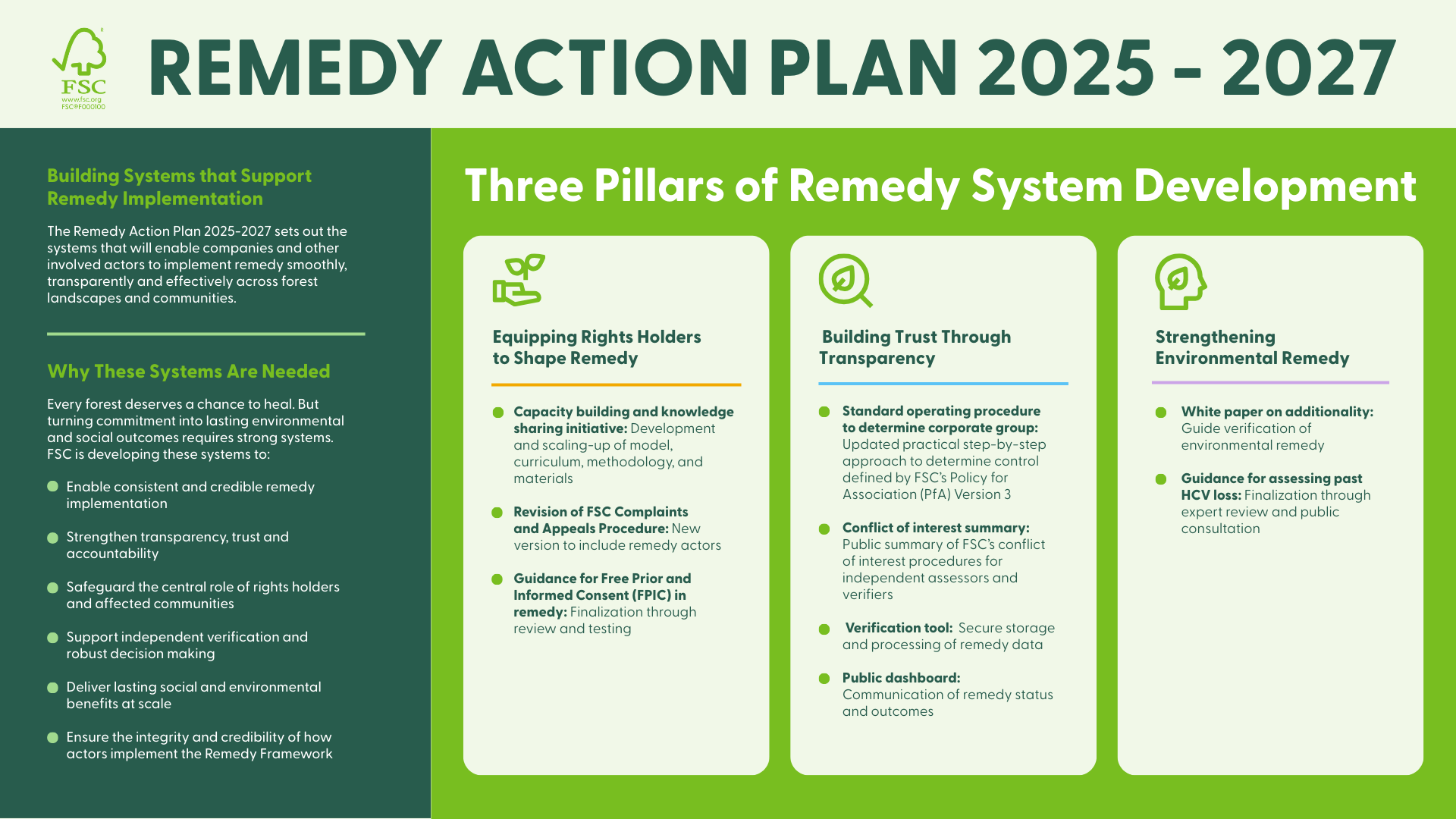
Methodology for identification of past HCVs and assessing HCV loss
FSC has worked with the High Conservation Value Network to develop draft guidance for the identification of high conservation values in a historical context, relevant for Remedy Framework Baseline Assessments. To view the document, click here.
-
Standard operating procedure to determine corporate group control
FSC has developed a standard operating procedure to determine implementable thresholds for each factor of control under the definition of corporate group under Policy for Association version 3 and to set out a step-by-step approach in internal reviews determining the scope of the corporate group. To view the document, click here.
-
Bahasa Indonesian translations of relevant documents
- FSC Policy for Association - version 3 (FSC-POL-01-004)
- FSC Policy to Address Conversion (FSC-POL-01-007)
- FSC Remedy Framework (FSC-PRO-01-007)
- FSC Remedy Framework (FSC-PRO-01-004)
- FSC Directive on Forest Management Evaluations (FSC-DIR-20-007)
- Advice Note on Scope of application of FSC Remedy Framework for outstanding magnitude or gravity of harm caused (ADVICE-10-004-01)
- Disclosure Requirements for Association with FSC (FSC-PRO-10-004)
System Development Status

Frequently Asked Questions
FSC maintains a detailed FAQ explaining how the Remedy Framework works, who it applies to, the role of FPIC, verification processes, thresholds, and other key concepts.
To explore the full FAQs, visit:
You also may be interested in